
Uneven Bars Inspection & Maintenance Guide
Uneven bars are one of the most frequently adjusted and mechanically complex apparatuses in a gymnastics facility. Regular inspection and maintenance are essential to help ensure athlete safety, maintain proper bar stability and tension, and extend the lifespan of the equipment. This guide is designed to help gym owners, coaches, and facility managers routinely evaluate their uneven bars for rail wear, loose hardware, cable tension, anchor security, locking function, movement, damage, and component failure.
Equipment ID System
Label each set of uneven bars with a unique identifier so it can be tracked consistently on monthly maintenance logs.
Example:
UB-01 = Uneven Bars 1
UB-02 = Uneven Bars 2
UB-03 = Uneven Bars 3
Track for each set of Uneven Bars:
- Brand / manufacturer
- Model number
- Location in gym
- Rail type
- Date installed
- Last maintenance date
- Last rail replacement date
- Current condition
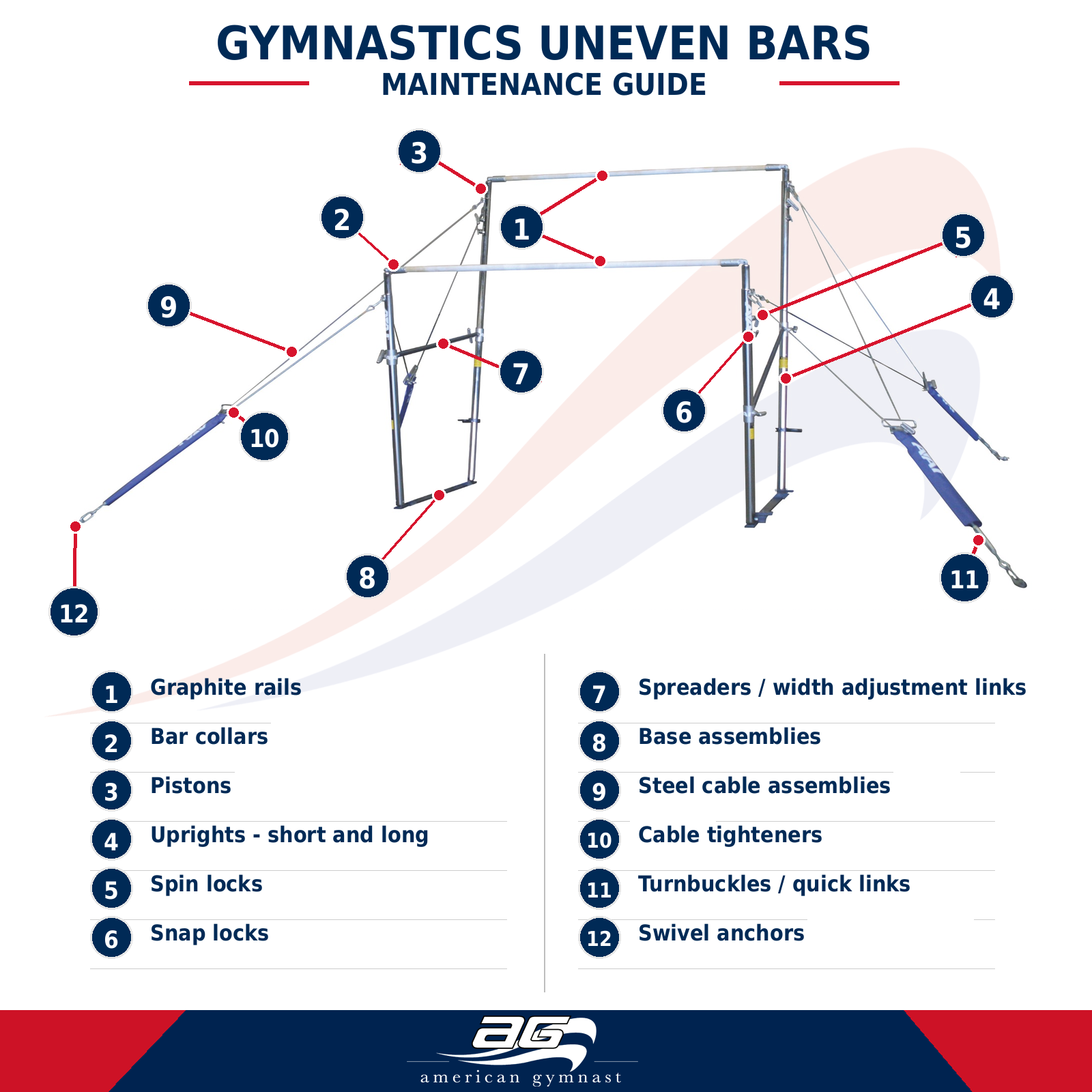
Uneven Bars Components to Inspect
1. Graphite Rails / Bars
What It Is
The rails are the athlete contact surfaces on the uneven bars. Depending on the model, AAI uneven bars may use Graphite X or Graphite E rails. These rails are constructed with fiberglass and graphite cores and wood veneer to provide strength, resiliency, and a wood-like feel.
What to Inspect
Check each rail for:
- Cracks
- Splintering
- Delamination
- Soft spots
- Excessive wear
- Unusual flex
- Loose or damaged rail-end connections
- Surface areas that feel rough, slick, or inconsistent
How Often
Visual and feel check: Before daily use
Detailed rail inspection: Monthly
Professional assessment: At least once per year
Signs of Wear
Rails may need attention if they show visible cracking, splintering, unusual flex, surface damage, or if athletes report that the rail feels inconsistent.
When to Take Action
Remove the bars from use if a rail is cracked, splintered, loose, or structurally questionable.
2. Bar Collars / Rail-End Connections
What It Is
The bar collars and rail-end connections secure each rail to the piston assembly. On AAI systems, the rail ends are attached to collars or castings that connect to the piston assembly with hardware.
What to Inspect
Check the rail-end connections for:
- Loose collars
- Damaged collars
- Missing hardware
- Loose bolts or nuts
- Movement between rail and collar
- Cracks around the connection area
- Unusual noise during use
How Often
Visual check: Weekly
Detailed hardware check: Monthly
Professional assessment: At least once per year
Signs of Wear
A rail-end connection may need attention if the rail moves inside the collar, if hardware loosens repeatedly, or if cracks or deformation are visible.
When to Take Action
Do not use the bars if a rail-end connection is loose, cracked, or unstable.
3. Pistons / Height Adjustment Tubes
What It Is
The pistons are the inner height adjustment tubes that slide into the uprights. They allow the high bar and low bar to be adjusted to different heights. AAI specifications describe the pistons as precision-machined heavy-wall tubing with grooves for height adjustment.
What to Inspect
Check each piston for:
- Bent tubing
- Damaged height grooves
- Difficulty sliding
- Rust or corrosion
- Scratches or gouges
- Height markings that are difficult to read
- Movement after the spin lock and snap lock are engaged
How Often
Function check: Each height adjustment
Visual check: Weekly
Detailed inspection: Monthly
Signs of Wear
Pistons may need attention if the bar is difficult to adjust, does not lock cleanly, slips, or has visibly damaged grooves.
When to Take Action
If a piston does not move smoothly or does not secure properly, remove the bars from use until the height adjustment system can be evaluated.
4. Uprights - Short and Long
What It Is
The uprights are the vertical frame members that support the pistons and rails. Uneven bar systems use short uprights for the low bar and long uprights for the high bar. AAI specifications describe the uprights as heavy-wall steel tubing with attachment points for locking devices and cable connections.
What to Inspect
Check the uprights for:
- Bent or damaged tubing
- Cracks
- Rust or corrosion
- Loose hardware
- Damaged cable attachment links
- Worn holes or attachment points
- Excessive movement during use
How Often
Visual check: Weekly
Detailed frame check: Monthly
Professional assessment: At least once per year
Signs of Wear
Uprights may need service if they appear bent, loose, cracked, or if the apparatus moves more than expected during use.
When to Take Action
Remove the bars from use if any upright appears structurally damaged or cannot secure the piston properly.
5. Spin Locks
What It Is
Spin locks are clamping and locking mechanisms that help secure the pistons in the uprights. AAI specifications describe the spin lock as a separate locking device that applies pressure to the piston and helps avoid relying on a single locking mechanism.
What to Inspect
Check each spin lock for:
- Smooth tightening and loosening
- Full engagement
- Loose handles
- Worn threads
- Stripped threads
- Damaged internal components
- Inability to hold the piston securely
How Often
Check during every height adjustment
Detailed check: Monthly
Professional assessment: At least once per year
Signs of Wear
A spin lock may need replacement if it does not tighten securely, slips, feels stripped, or does not hold the piston stable.
When to Take Action
Do not use the bars unless the spin locks are fully engaged and operating properly.
6. Snap Locks
What It Is
Snap locks are spring-loaded locating pins used to locate and secure the piston at the selected height. AAI specifications describe the snap lock as a spring-loaded hardened snap pin that provides visual and audible position locating.
What to Inspect
Check each snap lock for:
- Full engagement
- Smooth release
- Clear lock-in feel
- Damaged or worn pin
- Loose attachment nut
- Difficulty pulling or releasing
- Piston movement after locking
How Often
Check during every height adjustment
Detailed check: Monthly
Professional assessment: At least once per year
Signs of Wear
A snap lock may need attention if it sticks, does not fully engage, does not release properly, or allows the piston to shift.
When to Take Action
Do not use the bars if a snap lock is not fully engaged. AAI manuals specifically warn not to use the bars without both spin lock and snap lock engaged.
7. Spreaders / Width Adjustment Links
What It Is
Spreaders or connecting links control the width adjustment between the high bar and low bar. On AAI uneven bars, the width adjustment system uses adjustment links, slide collars, and locking assemblies to set the distance between the rails.
What to Inspect
Check the spreaders and width adjustment links for:
- Loose collars
- Damaged links
- Bent tubing
- Worn rod ends
- Missing hardware
- Spin locks that do not hold
- Uneven or inconsistent width setting
- Difficulty adjusting width
How Often
Function check: Whenever width is adjusted
Visual check: Weekly
Detailed check: Monthly
Signs of Wear
Spreaders may need attention if the width changes unexpectedly, the collars slip, the adjustment feels loose, or the linkage appears bent or damaged.
When to Take Action
Do not use the bars if the width adjustment system cannot be locked securely.
8. Base Assemblies
What It Is
The base assemblies support the uprights and help position the apparatus. AAI specifications describe the bases as fabricated steel plate assemblies with inserts or blocks used to connect the uprights.
What to Inspect
Check the base assemblies for:
- Cracks
- Bent base sections
- Loose upright connections
- Missing hardware
- Worn rubber treads
- Movement on the floor
- Rust or corrosion
- Uneven floor contact
How Often
Visual check: Weekly
Detailed stability check: Monthly
Professional assessment: At least once per year
Signs of Wear
Base assemblies may need service if they shift during use, do not sit flat, have worn treads, or show visible bending or cracking.
When to Take Action
Remove the bars from use if the base does not sit securely or if upright-to-base hardware is loose or damaged.
9. Steel Cable Assemblies / Guy Cables
What It Is
Steel cable assemblies, also called guy cables, help tension and stabilize the uneven bars. AAI specifications describe the guying cables as steel wire rope attached to the uprights with quick links and connected through turnbuckles and tie-downs to floor anchors.
What to Inspect
Check all cable assemblies for:
- Fraying
- Kinks
- Broken strands
- Corrosion
- Loose cable ends
- Damaged cable covers
- Uneven cable tension
- Cables rubbing against other components
How Often
Visual check: Before daily use
Detailed cable check: Monthly
Professional assessment: At least once per year
Signs of Wear
Cables may need replacement if they show fraying, broken strands, kinks, rust, or inconsistent tension.
When to Take Action
Do not use the bars if any cable is damaged, loose, or not properly tensioned.
10. Cable Tighteners
What It Is
Cable tighteners are used to lock and fine-tune cable tension after the turnbuckles are set. AAI’s cable tightener specifications describe the component as a steel assembly with rollers, handle, tightening rod, and hardware for cable attachment.
What to Inspect
Check each cable tightener for:
- Locked position
- Smooth operation
- Worn rollers
- Bent handle
- Damaged tightening rod
- Loose hardware
- Excessive wear
- Slipping during use
How Often
Check before daily use
Detailed check: Monthly
Replacement review: Annually or when excessive wear is evident
Signs of Wear
Cable tighteners may need replacement if they are difficult to lock, slip on the cable, have worn rollers, or show excessive wear.
When to Take Action
AAI recommends replacing cable tighteners annually or when excessive wear is evident, especially because repeated width adjustments can accelerate wear.
11. Turnbuckles / Quick Links
What It Is
Turnbuckles and quick links connect the cable assemblies to the chains, anchors, and upright attachment points. They are used to establish and maintain proper cable tension.
What to Inspect
Check all turnbuckles and quick links for:
- Closed quick links
- Tight quick links
- Bent or damaged links
- Worn threads
- Loose lock nuts
- Rust or corrosion
- Turnbuckles adjusted unevenly
- Chain connections seated properly
How Often
Visual check: Before daily use
Detailed hardware check: Monthly
Professional assessment: At least once per year
Signs of Wear
Turnbuckles or quick links may need replacement if they are bent, loose, corroded, difficult to tighten, or no longer close securely.
When to Take Action
Do not use the bars if any quick link is open, loose, damaged, or not tightened securely.
12. Swivel Anchors / Floor Anchors
What It Is
Swivel anchors and floor anchors secure the cable system to the floor. These are critical to the stability of cabled uneven bars.
What to Inspect
Check each anchor point for:
- Full engagement into the floor plate or floor anchor
- No gap between the swivel anchor plate and floor
- Dirty or damaged floor plates
- Loose anchors
- Damaged threads
- Corrosion
- Movement during use
How Often
Check before daily use
Detailed check: Monthly
Professional assessment: At least once per year
Signs of Wear
Anchor systems may need attention if the anchor does not fully thread into the floor plate, if there is a visible gap, if the floor plate is damaged, or if the anchor moves during use.
When to Take Action
Do not use the bars if the anchor tie-downs are not fully engaged into the floor anchors. AAI manuals warn that improperly installed or dirty floor plates can create a dangerous situation and may result in anchor failure.
Protective Pads & Cable Covers
What They Are
Protective pads help cover uprights, chains, turnbuckles, and tension cable areas. AAI’s competition uneven bar pad set includes chain and turnbuckle pads as well as upright pads that attach using Velcro.
What to Inspect
Check protective pads and cable covers for:
- Proper placement
- Secure Velcro attachment
- Torn vinyl
- Damaged foam
- Missing pads
- Exposed hard surfaces
- Pads shifting during use
- Worn cable covers
How Often
Visual check: Before daily use
Detailed check: Monthly
When to Take Action
Replace or repair pads that are torn, missing, loose, or no longer covering the intended components.
Safety Mats
What They Are
Safety mats provide the landing and protection area beneath and around the uneven bars.
What to Inspect
Check mats around the uneven bars for:
- Proper placement
- Adequate coverage
- Gaps between mats
- Compressed foam
- Torn covers
- Shifted mats
- Exposed hard surfaces
How Often
Visual check: Before daily use
Detailed check: Monthly
When to Take Action
Do not use uneven bars without adequate safety mats beneath and around the apparatus. AAI’s manuals state that adequate safety mats should always be used beneath the equipment.
When to Remove Uneven Bars from Use
Remove the uneven bars from use if:
- A rail is cracked, splintered, loose, or damaged
- A spin lock or snap lock does not engage properly
- Any cable is frayed, kinked, corroded, or damaged
- A cable tightener does not lock securely
- A quick link is open or loose
- A turnbuckle is bent, loose, or damaged
- Any anchor is not fully engaged into the floor plate
- There is movement at the base or upright connection
- Protective pads or safety mats are missing or improperly placed
- Any part of the apparatus appears damaged or defective
AAI’s manuals state that damaged or defective equipment should not be used and should be labeled “DO NOT USE” until repaired or replaced.
Replacement Parts
Common uneven bar replacement parts may include:
- Rails
- Bar collars
- Pistons
- Uprights
- Spin locks
- Snap locks
- Adjusting collars
- Spreaders / connecting links
- Base assemblies
- Rubber base treads
- Cable assemblies
- Cable tighteners
- Turnbuckles
- Quick links
- Swivel anchors
- Floor plates
- Protective pads
- Cable covers
- Landing mats
Schedule an American Gymnast Gym Assessment
American Gymnast recommends scheduling a professional Gym Assessment at least once per year. Between professional assessments, gym owners, managers, and coaches should monitor equipment regularly and keep a written record of equipment condition.